
Teaching and Learning at Carisbrooke

Principles of Teaching and Learning
Commitment to Great Teaching
We put students at the heart of everything we do; every child deserves an excellent education ensuring exceptional outcomes and opportunities.
Championing fairness and inclusion to ensure every student has the support and opportunities they need to succeed, regardless of their background, is central to everything we do. Our responsibility is to ensure that every student experiences a consistently high-quality curriculum and teaching that enables them to thrive, achieve and fulfil their potential.
Evidence indicates that high-quality teaching is the most important lever schools have to improve outcomes for their students. Our Practice Framework enables strong classroom practice to provide the best foundation for every learner, including those with additional needs. By designing learning that is ambitious, accessible and responsive from the outset, we create classrooms where all students can succeed while maintaining high expectations for every child.
Mental Models
Teaching is complex, learning is invisible. Mental models that combine research and classroom experience, help maximise our impact in the classroom.
It is challenging to build a rigorous mental model of cognition through classroom experience alone. Every lesson requires hundreds of professional decisions, many of which happen in the moment. By aligning our evidence-informed models of learning, teaching and professional development, we codify our practice into clear, actionable and shared routines.
Throughout our Practice Framework, our mental models provide a common lens through which we can reflect on practice, solve problems and make consistent decisions.
Every decision we make as teachers should be informed by how students learn. Before we consider teaching, we first need to understand how learning happens.
Simple Mental Model of Learning:
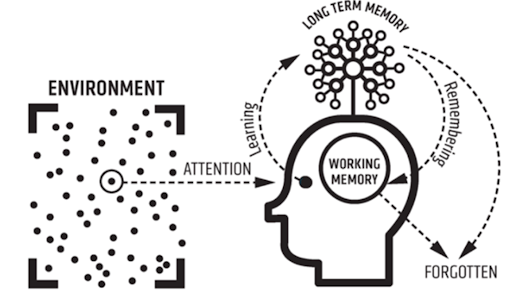
How learning happens:
Learning is a complex process. Decades of research show that there are common principles that explain how learning happens for everyone.
Environment and Attention: Attention is the gateway to learning. Students only learn what they attend to. In a classroom there is a lot of sensory information.
Working Memory: Working memory is the thinking part of the brain that processes information from the environment, as well as drawing on knowledge from the Long-term memory. It is limited in capacity, can be overloaded, and items can only be held in WM for a short period of time. WM enables us to hold information in mind while we mentally manipulate it. It is useful to think of WM as a mental jotting pad. For learning to happen, students must transfer information from WM to the LTM.
Learning: Memory is the residue of thought. By thinking hard about something, new knowledge can be transferred from the WM to the LTM where it is stored. The deeper the level of processing, the better the retention.
Long Term Memory: Learning is a permanent change in LTM. LTM can be considered as a store of knowledge that changes as students learn by integrating new ideas with existing knowledge. The amount of information it can hold is essentially infinite. Once new information passes into the LTM it is organised and packaged into mental structures of already learnt knowledge called schemas.
Remembering: Understanding is remembering in disguise. Retrieval is a powerful way to strengthen the retention of knowledge.
Forgotten: If the working memory is overloaded, and knowledge hasn’t been integrated into schema in the long-term memory, then it is forgotten. New knowledge is easily forgotten if it’s not used.
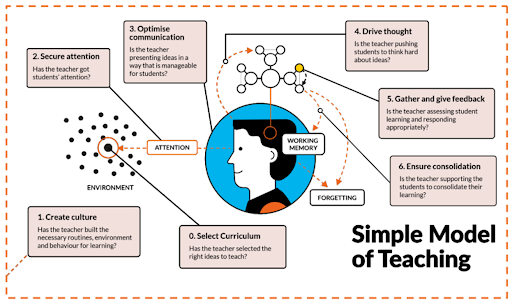
Understanding how learning happens has implications for how we teach. There are six universal teaching problems that every teacher navigates. By understanding these six universal teaching problems, we gain a clearer lens on our teaching practice, so we can become more intentional in the classroom, using the best available evidence to help every student.
0: Select curriculum - It is vital that we have selected the right content for our students to learn, and that we’ve sequenced it carefully.
1: Create culture - Once we’re in the classroom we need to start to think about the social and emotional side of learning. Students feel better when they feel safe, included and motivated. That’s why the foundation of teaching is to create culture. Culture is ‘the way we do things around here’. When culture is right, students feel seen, supported and ready to engage.
2: Secure attention - Everything we learn passes through working memory, before it can be filed in long term memory. To learn, students therefore need to be focusing on the right things. Because working memory is easily overloaded, one of our most important jobs as teachers is to secure attention.
3. Optimise communication - Due to the limitations of working memory, we need to keep explanations clear and to break down information into manageable chunks.
4. Drive thought - Information only transfers to long term memory when students actively think about it. That’s why strategies like questioning, group discussion and paired talk really work.
5. Gather and give feedback - Learning is never neat and tidy. There will always be variation in what students learn because they each have different prior knowledge and experiences, through which they make sense of any new information. Mistakes, confusion and misunderstanding are inevitable. This is why it’s important that we regularly check for understanding and provide feedback.
6. Consolidation - Knowledge is easily forgotten if it isn’t used. It is therefore important to help students strengthen what they have learnt through frequent practice and retrieval. Every time students recall something they have previously learnt, it becomes more secure in their long-term memory. Reference: Steplab Evidence Informed Teaching course
Links to our Curriculum Towers
Disciplinary Literacy & Vocabulary: Explicitly teaching subject language so students can express complex ideas with confidence and precision.
Memory, Retrieval & Mastery: Deliberately revisiting key concepts over time so knowledge sticks for life, not just for an exam.
Inclusion, SEND & Disadvantage: Scaffolding support so every student accesses ambitious learning without barriers.
Our Principles for Inclusive Teaching
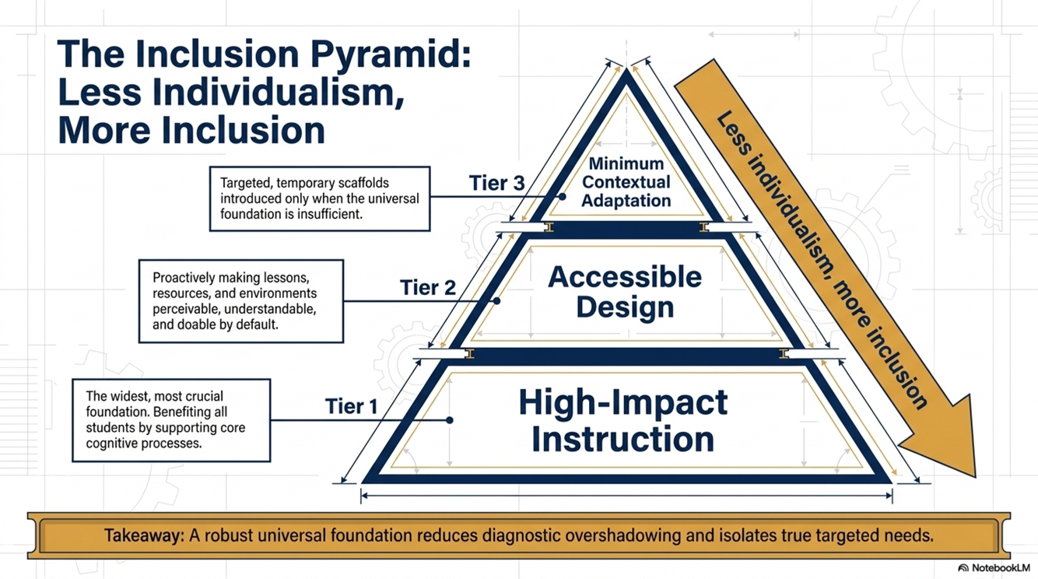
High-quality teaching is the foundation of inclusion. These evidence informed five principles underpin our approach to ensuring every student can access, participate in and succeed through consistently excellent classroom practice.
1. Embrace Cognitive Similarity
Although students have different strengths and needs, the core processes of learning (attention, memory, and understanding) are largely shared. Effective teaching should start by focusing on these common learning mechanisms rather than assuming fundamentally different approaches are needed for different groups of learners. Strong universal teaching benefits everyone and makes it easier to identify those who need additional support. SEND support should build on high-quality classroom teaching, with specialised interventions added only where necessary.
2. Prioritise High-Impact Core Instruction
The quality of whole-class teaching is the most important factor in supporting students with SEND. Students with additional needs gain the most from clear, structured, evidence-informed instruction. Effective strategies include explicit teaching, strong routines, positive relationships, cognitive load management, retrieval practice, frequent checking for understanding, and maintaining attention and motivation. Good teaching is not separate from SEND support—it is the foundation of it.
3. Make Lessons Accessible by Default
Lessons should be designed from the outset to be usable and understandable for the widest possible range of students. Accessibility involves ensuring learning is perceivable (clear resources, good acoustics, uncluttered layouts), understandable (clear language, modelling, broken-down instructions, established routines), and doable (appropriate scaffolding, sufficient processing time, accessible equipment). Proactively removing barriers reduces the need for reactive adaptations.
4. Adapt Minimally and Appropriately
When universal provision is not enough, adaptations should be targeted, proportionate, and focused on overcoming specific barriers. The goal is to help students access the same core learning alongside their peers, rather than creating separate learning experiences unnecessarily. Adaptations should be informed by ongoing assessment, reviewed regularly, and gradually reduced when possible. Examples include additional scaffolding, re-explanation, strategic pairing, or assistive technology, rather than lowering expectations or removing students from lessons.
5. Empower Effective Teacher Assessment
Inclusive teaching relies on teachers using ongoing formative assessment to understand individual learning needs in real time. Diagnoses can provide useful context but should not determine teaching approaches on their own. Teachers should use observations, questioning, work analysis, and professional judgement to identify the specific barriers a student faces. Effective support requires flexibility, context-sensitive decision-making, and systems that enable teachers to focus on responsive teaching.
Reference: Inclusive Teaching: A New Approach for SEND Challenges
Mechanisms for Effective Professional Development
Great learning begins with great teaching, and great teaching is developed through high-quality professional development. For that reason, we have intentionally included the evidence underpinning our approach to professional development. If we are serious about improving outcomes for every student, we must be equally serious about how we design, deliver and sustain professional development. The evidence below highlights the mechanisms that research shows are most likely to lead to lasting improvements in teaching and, ultimately, better outcomes for children.
The Education Endowment Foundation (EEF, 2021) identifies that the effectiveness of professional development depends not simply on its content, but on how it is designed. Professional development is most effective when it includes specific evidence-informed mechanisms that change practice. These mechanisms are the core building blocks of professional development: they are observable, replicable and supported by research on human behaviour, demonstrating their ability to bring about sustained improvements in professional practice.
Professional Development Through Steplab
Our Practice Framework sets out our shared understanding of high-quality curriculum and teaching. StepLab supports its implementation by connecting professional development directly to classroom practice.
Through low-stakes drop-ins, rehearsal, feedback and shout-outs, teachers and leaders engage with the principles within this Practice Framework everyday. This supports our commitment to students First, recognising that strengthening teaching is the greatest contribution we can make to improving outcomes for every learner.